Wholefoods Perfumes Making us Sick
Most grocery stores are built its reputation on one promise: clean.
Clean ingredients. Clean sourcing. Clean labels. A store where health-conscious shoppers could trust that what they were putting in their bodies — and bringing home to their families — met a higher standard than the average grocery chain.
But something has changed. And the MCS community is done staying quiet about it.
Across the country, shoppers with Multiple Chemical Sensitivities, asthma, MCAS, and fragrance sensitivity are reporting the same experience: walking into a Whole Foods and being hit by a wall of synthetic fragrance. Not from other shoppers. Not from the cleaning products. From merchandise — scented candles, perfumed soaps, fragranced bath bombs and body products — displayed in open proximity to produce, bulk foods, pet food, and other consumables.
And those synthetic fragrances? They stick. To your organic apples. To your spinach. To the dog food you feed your pet. To the bread you bring home for your kids.
This is not a minor inconvenience. For millions of Americans, it is a health crisis happening inside a store that markets itself as a sanctuary for health.
The Science of Fragrance Transfer
Synthetic fragrances are not passive. They are volatile — meaning they actively off-gas chemical compounds into surrounding air and surfaces.
The same research that identified over 25 volatile organic compounds (VOCs) in residential dryer vent emissions — including benzene and acetaldehyde, both classified as carcinogens by the EPA — applies directly to open fragrance displays in enclosed retail spaces.
When scented products are displayed near food, produce, or pet food in a shared indoor air environment, those VOCs do not stay put. They migrate. They settle onto surfaces. They absorb into porous materials — including the skin of fruits and vegetables, the packaging of bulk foods, and the paper bags holding your groceries.
One in three people has a debilitating health reaction to synthetic fragrance, including seizures, migraines, and asthma attacks.
Source: doi.org/10.1007/s11869-019-00672-1
For people with MCS or MCAS, inhaling those compounds while simply trying to buy groceries can trigger reactions that last hours or days after leaving the store.
What the MCS Community Is Experiencing at Whole Foods
The Facebook group Fragrance Free Living 100% and MCS communities across the country are documenting similar complaints:
- Groceries coming home smelling like cologne or perfume — not from other shoppers, but absorbed during time in the store.
- A persistent "Whole Foods smell" that customers describe as a full-store chemical fog — potentially from scented cleaning products, scent marketing systems, or fragrance migration from product displays.
- Employees wearing heavy fragrance while handling food and produce — and that fragrance transferring to refrigerated items, bulk bins, and packaged goods.
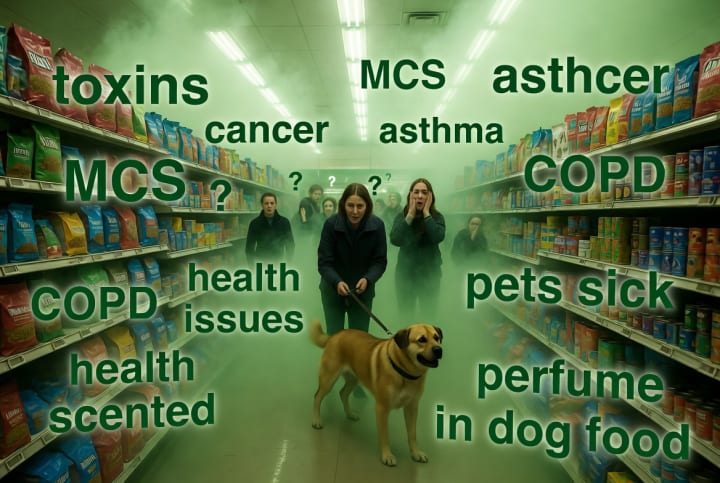
Pet food and dry goods absorbing synthetic fragrance from nearby displays.
Whole Foods corporate has been contacted. The number shared widely in MCS communities is 1-844-936-8255. The ask is clear: implement a fragrance-free employee policy, move strongly scented merchandise away from food and produce aisles, and investigate the store-wide smell that is making shoppers sick.
So far, for too many shoppers, nothing has changed.
Why This Matters Beyond the MCS Community
Even if you have never heard of Multiple Chemical Sensitivities, this issue should concern you.
Synthetic fragrance ingredients — including phthalates, used to make scents last longer — are endocrine disruptors. They interfere with hormonal function. They have been linked to reproductive harm, developmental problems in children, and increased cancer risk with long-term exposure.
Manufacturers are not required to list fragrance chemicals on labels. A single "fragrance" entry on an ingredient list can represent hundreds of individual compounds — none of which are disclosed to the consumer.
When those compounds migrate from open retail displays onto your food, you are consuming chemicals you were never told were there.
That is not a clean store. That is a liability masquerading as wellness.
The Irony Whole Foods Cannot Ignore
Whole Foods spends enormous resources ensuring the food on its shelves meets rigorous standards. It bans hundreds of ingredients from its products. It markets heavily to health-conscious consumers who are willing to pay premium prices precisely because they trust the Whole Foods standard.
And then it places an open display of synthetic fragrance products — candles, bath bombs, perfumed soaps — next to the organic strawberries.
The community asking Whole Foods to change this is not a fringe group. It is 55 million Americans with chemical sensitivity. It is the one in three shoppers who experience a measurable health reaction to synthetic fragrance. It is parents buying food for children. It is pet owners buying food for animals who cannot advocate for themselves.
It is people who chose Whole Foods specifically because they believed it was different.
What We Are Asking Whole Foods to Do
The requests from the MCS and fragrance-sensitivity community are specific, reasonable, and entirely achievable:
Move scented merchandise displays away from all food, produce, bulk goods, and pet food aisles. Fragrance products belong in a contained section with proper ventilation — not adjacent to consumables.
Implement a fragrance-free employee policy for staff who handle food and interact with customers in food areas. Many hospitals, schools, and government offices already have these policies. Whole Foods can too.
Investigate and address the store-wide fragrance smell that shoppers report is transferring to groceries. Whether it originates from cleaning products, scent marketing systems, or product placement — it needs to be identified and eliminated.
Provide at minimum one shopping hour per week that is fragrance-controlled — similar to sensory-friendly shopping hours already offered by some major retailers for customers with autism and sensory processing disorders.
If you agree, call Whole Foods corporate at 1-844-936-8255 and make your voice heard. Politely. Clearly. Repeatedly.
Every call matters.
A Final Word
Whole Foods, you built something people believe in. You created a space that millions of Americans trust with their health and the health of their families.
You have the knowledge, the resources, and the brand reputation to lead on this issue — not follow.
Fifty-five million Americans with chemical sensitivity shop for groceries somewhere. Many of them chose you because they thought you were different.
Prove them right.
Have you experienced fragrance contamination at Whole Foods or another grocery store? Share your experience in the comments. The more voices that speak up, the harder this is to ignore.
Call Whole Foods corporate: 1-844-936-8255
Source: doi.org/10.1007/s11869-019-00672-1
Recent consumer reports indicate that some shoppers are experiencing significant issues with fragrance contamination in products purchased from Whole Foods Market. Reports suggest that food packaging, produce, and bulk items sometimes arrive smelling strongly of perfumes, cologne, or scented cleaning products.
Suspected Sources of Contamination
According to customer complaints, the scent transfer is attributed to several potential sources:
Employee/Cashier Scent: Strong perfumes, colognes, or hand lotions worn by staff can transfer to items during checkout.
Restroom/Store Scenting: Some stores have used, or currently use, scent atomizers or air fresheners in restrooms and general areas that drift throughout the store, impacting food items.
Product Placement: Placing scented soaps or laundry detergents near food, specifically in checkout areas or neighboring aisles, can result in cross-contamination.
Recycled Materials: Some customers report that the scent clings to recycled materials in shopping bags or food packaging.
Cleaning Agents: Floor cleaning fumes or strong cleaning products used in the store can impact food smell.
Customer Impact and Concerns
Food Safety and Health: Customers have reported that the scent makes items unusable and have expressed concerns about chemical contamination in food. Some reported physical reactions like headaches and migraines.
Return Rates: Customers have returned entire orders after finding their food smelled of soap or perfume, with some reporting that the smell sticks to bags and even home storage areas.
Feedback: Affected customers have been advised to call Whole Foods corporate to request a fragrance-free policy for employees and to discontinue the use of scenting agents in stores.
While some reports suggest that specific stores have previously removed scent diffusers due to complaints, the problem has reappeared in different forms, such as through soaps or cleaner products.
Comments
Post a Comment